
Would President Trump’s proposed arch be safe, or would it impact flights to and from Washington Reagan National Airport (DCA)? That is the honest question to ask about a 250-foot monument proposed for the western end of Arlington Memorial Bridge, less than two miles up the Potomac from DCA. It deserves a technical answer rather than a partisan one, so we examined the problem using FAA methodology, published criteria, charts, and coordinates.

The Triumphal Arch for Washington, DC's Memorial Circle, courtesy Harrison Design
The answer came back in two parts. The safety question depends entirely on who is flying, what kind of aircraft they are flying, and where they are flying.
For the airliners everyone is arguing about, the arch is very likely a non-event. For the helicopters almost nobody has mentioned, it is a real and largely undiscussed problem. And the analysis raised a second question we had not gone looking for, one that has nothing to do with this monument and everything to do with how decisions like it get made. It raised concerns about the process itself, and about a question with a long pedigree: who is watching the watchers?
A word on what this article does and does not do. It takes no position on whether the arch should be built, on who wants it, or on what it commemorates. Those are questions of civic design, law, and public preference, and others are debating them. What follows tests whether the aviation objections are technically supported — and then reports what the process for answering them actually looks like, and identifies a potential flaw in that process.
The proposal in aeronautical terms
The project has been given several names by different organizations; this article refers to it simply as the arch. The announced site is Memorial Circle, on Columbia Island at the Virginia end of Memorial Bridge, directly across the river from the Lincoln Memorial. The announced height is 250 feet above the ground. Aviation does not much care about height above the ground; it cares about height above mean sea level (MSL), because that is the reference for every altitude a pilot flies. The site sits roughly 29 feet above sea level, which puts the top of the arch at approximately 279 feet MSL. It lies about 1.8 nautical miles northwest of the threshold of Runway 19 — the north end of DCA’s main runway — and just under a mile west of that runway’s extended centerline, on the west bank of the river nearly every aircraft using the airport follows.
How the system evaluates a tall structure
Long before anyone asks whether a structure is a hazard, federal regulation asks a simpler question: Is it tall enough and close enough to an airport to require a look? The framework is 14 CFR Part 77 of the Federal Aviation Regulations, and it uses ratios of distance and height. Any structure more than 200 feet in height above the ground level at its site requires notice to the FAA no matter where it stands (§ 77.9(a)). Note the reference: that threshold is measured above the ground at the site, not above sea level — the only place in this analysis where the ground is the datum. Closer to an airport, the threshold drops along a 100-to-1 slope: within 20,000 feet of the nearest point of the nearest runway, a structure needs FAA review if it rises more than 1 foot for every 100 feet from that runway (§ 77.9(b)). At the arch site — roughly 11,000 feet from the end of the nearest runway — that notice threshold is about 110 feet above the airfield. A 250-foot structure there requires review twice over.
Notice is only the entry point. Part 77 then defines a set of imaginary surfaces over and around every airport — a ceiling and sloped shoulders, in effect — and asks whether the structure pokes through them (§ 77.19). Over the airport itself lies the horizontal surface, 150 feet above the established airport elevation, extending in 10,000-foot arcs from each runway end; at DCA, whose field elevation is about 15 feet MSL, that surface lies at roughly 165 feet MSL (§ 77.19(a)). Beyond the arcs, the conical surface slopes upward at 20 to 1 — one foot up for every 20 feet outward — for a horizontal distance of 4,000 feet (§ 77.19(b)). The Memorial Circle site falls just outside the horizontal-surface arcs, placing the conical surface at approximately 175 to 210 feet MSL above Memorial Circle, depending on the exact survey point. An arch topping out near 279 feet MSL would penetrate that surface by something on the order of 65 to 105 feet.
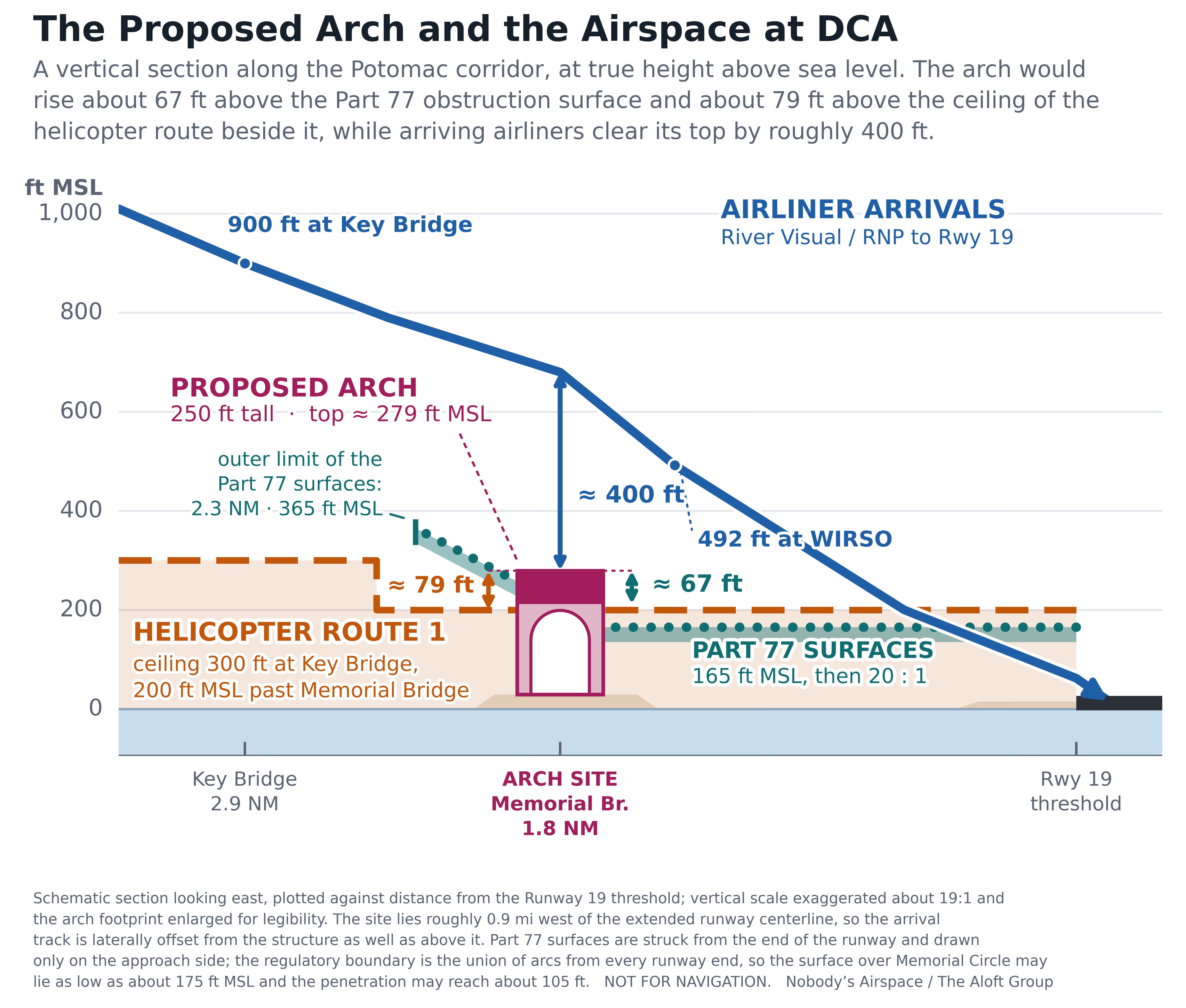
Figure 1. The Part 77 surfaces at Washington National in perspective: the horizontal surface at 165 feet MSL, the conical surface rising 20 to 1 from its edge, and the proposed arch penetrating the cone — above the helicopter corridor, below the arrival path. Schematic; vertical scale exaggerated.
Penetrating a Part 77 surface (visualize an imaginary plane) makes a structure an obstruction, and here a distinction matters that public discussion routinely misses: an obstruction is not automatically a hazard. Washington is full of obstructions, and the arch would not even be the first to break these particular surfaces. By the same computation used here, the Washington Monument — just outside the arcs on the other side of the river — stands roughly 400 feet above the conical surface, and the Air Force Memorial’s spires beside the Pentagon stand roughly 235 feet above the horizontal surface itself. Farther out, Alexandria’s Masonic Memorial and the Rosslyn high-rises sit beneath the river corridor and were shaped by the same process; Rosslyn tops out around 400 feet for exactly that reason. Every one of them was studied, determined, charted, and lit, and the airspace was designed around them.
What a penetration does is trigger a formal aeronautical study, in which the FAA evaluates the structure against the criteria that actually govern where aircraft fly. That criterion is found in the United States Standard for Terminal Instrument Procedures, known as TERPS and published as FAA Order 8260.3, which prescribes minimum obstacle clearance for every segment of every instrument approach and departure. The TERPS contain obstacle clearances that vary with the procedure, the segment, and the aircraft’s speed category, along with the surfaces protecting visual approaches, and the published helicopter route structure. The study, not the ratio, is where the real answer lives. It ends in a determination: no hazard, no hazard with conditions such as marking and lighting, or a determination of hazard (§ 77.31).
The geography
The chart below shows the arrangement. The blue line is the path of airliners arriving on Runway 19, the River Visual Approach, and collocated instrument procedures, descending along the Potomac past Georgetown, Key Bridge, and Memorial Bridge to the runway. The green line is the reciprocal: Runway 1 departures climbing back up the river. The orange line is published Helicopter Route 1, which follows the same water. The star is the proposed arch.
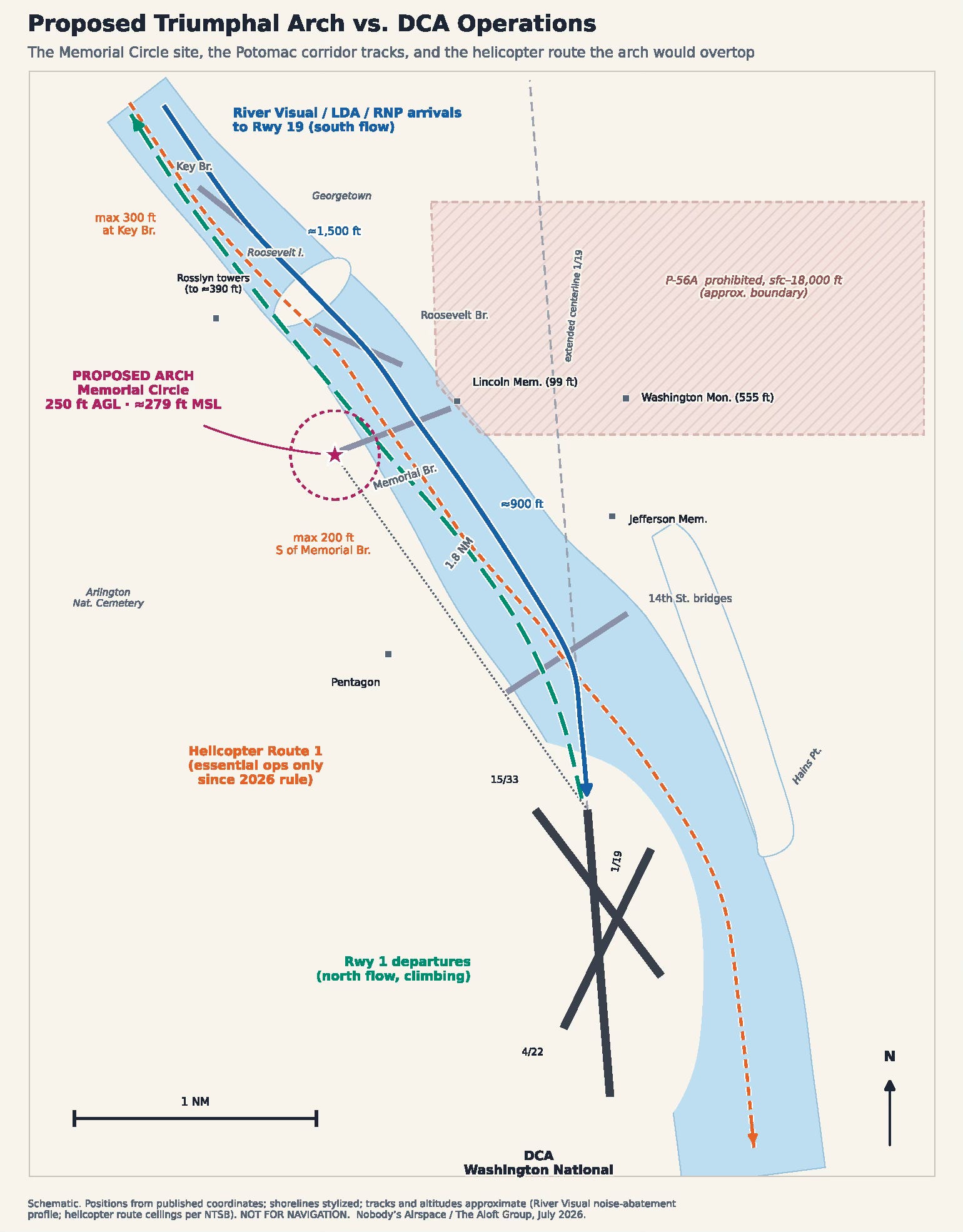
Figure 2. The proposed arch site relative to arrival, departure, and helicopter tracks at Washington National. Positions from published coordinates; altitudes approximate; not for navigation.
Who is flying what, to where? It matters — start with the airliners
For the airline traffic, the numbers are reassuring — and lower-stakes than the public argument suggests. Some discussion of the arch has described airliners passing over the site at about 500 feet above ground on final approach. That does not match the published procedures. On the River Visual Approach, aircraft are charted at 1,500 feet abeam the Georgetown Reservoir and cross Key Bridge at 900 feet, descending over the river — laterally offset from the arch site — through the Memorial Bridge reach. On the RNAV (RNP) Z Runway 19 approach, which follows the same water when weather requires an instrument procedure, aircraft cross the WIRSO waypoint, 1.4 miles north of the runway and still over the river, at 492 feet. Aircraft do not descend through 500 feet until they are south of the site.
Departures off Runway 1 pass the site climbing, typically through 1,000 to 2,000 feet. Against a 279-foot obstacle, arrivals descending through the Memorial Bridge reach retain vertical margins on the order of 400 feet, with a lateral offset besides; departures retain substantially more. That is not generous by the standards of airspace design anywhere else in America; almost nothing about this airport is generous. But those margins are consistent with the FAA’s preliminary look, which reportedly found no significant adverse effect on the airport’s fixed-wing procedures and called for red obstruction lighting. So, the finished arch should not affect airline operations.
The building of it is a different matter. Erecting a 250-foot masonry structure requires cranes taller than the structure. Congressional correspondence to the FAA describes cranes of 300 to 320 feet, roughly 330 to 350 feet above sea level, with the Park Service estimating construction at as much as 20 hours a day over a period of 2 to 3 years.
Temporary structures are evaluated under the same rules as permanent ones, and a 350-foot crane penetrates the surfaces described above half again as deeply as the arch itself. Cranes rise near airports all the time under negotiated conditions, and a lit crane is a known quantity in aviation. But a multi-year crane presence at this particular bend of the river, beneath a visual approach flown day and night, in all seasons, at one of the most tightly constrained airports in the country, is a substantial aeronautical event in its own right. It deserves its own study, its own conditions, and its own scrutiny, and it is not obvious that it has received any of the three.
Don’t forget the helicopters
The major concern is not the airliners descending several hundred feet overhead. It is the helicopters at 200 feet.
The published helicopter route structure along the Potomac was designed decades ago to thread rotary-wing traffic beneath the fixed-wing flows at DCA. Route 1, a published helicopter only route, follows the river past the arch site, and its charted maximum altitudes step down as it approaches the airport: 1,300 feet up near Cabin John, 700 feet below Chain Bridge, 300 feet at Key Bridge, and 200 feet above sea level just south of Memorial Bridge, the arch’s front yard, and a compulsory reporting point on the route. These routes, as the National Transportation Safety Board (NTSB) has noted, have no defined lateral boundaries; they are drawn as linear paths along surface features, and the chart carries no requirement to keep any defined distance from the shoreline. A structure rising to approximately 279 feet MSL at Memorial Circle would stand at or above the ceiling of the corridor immediately beside it. The construction cranes would stand 100 to 150 feet above that ceiling.
That is the arithmetic separating the helicopter question from the airline question: the airliners clear the top of the arch by roughly 400 feet, while the helicopter corridor’s ceiling is below it.
It matters who is flying there. After the January 2025 midair collision between an airliner and an Army helicopter near this airport, where 67 lives were lost, the FAA closed the segment of Route 4 involved, eliminated mixed helicopter and fixed-wing traffic, and, by rule in early 2026, prohibited helicopter operations over this stretch of the Potomac at or below 1,500 feet except for essential missions: lifesaving medical flights, active law enforcement, air defense, continuity of government, and presidential and vice-presidential transport. The traffic that remains in the corridor beside Memorial Circle is, by definition, the critical traffic that cannot be rescheduled or rerouted. Much of it is flown at night, some of it on night-vision devices, all of it low, precisely because the airspace above belongs to the airliners. A new obstacle at the ceiling of that corridor cannot be solved by asking the remaining users to go around. Going around is what every discretionary user of this airspace has already been ordered to do.
Obstruction lighting, the condition attached to the FAA’s preliminary review, addresses conspicuity, i.e., whether pilots can see the structure. It does not address geometry. An obstacle at or above the ceiling of an active low-level route is not a visibility problem; it is a design conflict, and there are only three ways out of this: raise the route, move the route, or accept a permanent reduction in the margins the route was drawn to provide. Raising the route presses helicopters up toward the fixed-wing flows — the very conflict the post-2025 restructuring was written to eliminate. Moving the route runs into the reason the route exists: the river is the route. Which of these the FAA chooses, or what combination of route amendment, altitude change, and operating restriction, is exactly the kind of question a full aeronautical study exists to answer. It is not necessarily unsolvable, but no one has offered a solution yet.
Where the record stands
That comprehensive study has not been done. The sequence to date, from the public record: in February 2026, no filing for the arch existed in the FAA’s obstruction-evaluation system. In May, the National Park Service submitted the project for review, and the FAA confirmed that it was reviewing it. In June, the agency completed what it described as a limited review, reportedly finding no significant adverse effect on the airport’s airspace and procedures and requiring red obstruction lighting, while committing to a comprehensive aeronautical study before construction begins. In July, the National Capital Planning Commission granted preliminary site and building approval. No formal FAA determination has been published, and the comprehensive study — the process that addresses precisely the questions raised above, the helicopter questions in particular — remains outstanding.
So the answer to the first question is: yes, there is a real technical issue here, but it is not the one being argued about. And that finding led to the second question, which may be the most concerning.
The greater risk is, who is watching the watchers?
The aviation calculations in this article are based on FAA-published criteria, charts, and procedures, together with published coordinates and project data. The 100-to-1 notice slope, the 150-foot horizontal surface, the 20-to-1 conical, the TERPS clearances, and the charted route ceilings. None of these are opinions, and none of them are mine. They are the government’s own arithmetic, printed in the government’s own documents and applied for decades to every developer, county, and memorial commission that ever wanted to build something tall near an airport. The system earns respect for one reason above all: the criteria are applied the same way regardless of who is asking.
Which raises the question of what happens when the asker is unusual. The FAA is an executive-branch agency headed by a presidentially appointed Administrator. The applicant here is, in effect, the executive branch itself. The Park Service submitted the request; the project was directed by the White House; and the planning commission granted preliminary approval before the comprehensive study was conducted. The published criteria will not change; numbers in a regulation never do. What the process has to demonstrate is its integrity and that its interpretation cannot be made to change either.
But the question about the fairness of the evaluation process highlighted a more complex issue related to governance of any similar situation — not just the Memorial Circle arch.
Aeronautical studies are conducted by the FAA. If you disagree with the outcome, Part 77 gives you thirty days to file a petition for discretionary review, which must present information the agency did not previously consider (§ 77.39). That petition is filed with the FAA and decided by the FAA. If the agency declines to grant review, its own determination stands as final. The appeal from the referee’s original decision, in other words, goes to the referee.
And the determination binds no one.
This is the part people outside the system find hardest to believe. The FAA can study a structure, find it a hazard to air navigation, and issue that finding, yet the structure can still be built. That is not an inference from the regulation’s silence; it is settled law.
The governing statute, 49 U.S.C. § 44718, authorizes the agency to require notice, conduct an aeronautical study, and issue a report. It confers no power to approve, disapprove, condition, or enjoin. The D.C. Circuit stated the consequence plainly in Aircraft Owners and Pilots Association v. FAA (1979): a hazard determination “has no enforceable legal effect,” and the FAA “is not empowered to prohibit or limit proposed construction it deems dangerous to air navigation.” The court said it again in Town of Barnstable v. FAA (2011), describing FAA hazard determinations as advisory and identifying the Department of the Interior as the authority that actually controlled whether that project went forward. The agency’s own briefing materials are blunter still — an FAA presentation to the Aeronautical Charting Forum states that FAA determinations “are not construction permits” and that the “FAA does not have land use authority.”
What actually stops a building is something else: state or local zoning that has written the Part 77 surfaces described earlier into its own code, so that breaking one of those imaginary planes violates the local ordinance even though it violates no federal prohibition; an airport sponsor’s federal grant assurances; the Federal Communications Commission’s refusal to register a communications tower without a valid no-hazard determination; or, on federal land, the agency that manages the land.
That last category is where a determination acquires real force. Where a land-managing agency has conditioned its own approval on the FAA’s answer, a hazard finding does effectively stop a project — that was the situation in a 2008 case involving wind turbines on Bureau of Land Management property, and a court described the FAA determination there as precluding construction. The distinction matters: the determination did not stop the turbines; the land manager did.
In this case, the land at Memorial Circle is federal and managed by the National Park Service, the applicant. The body with the expertise has no power to stop. The body with the power to stop is the one asking.
A timing detail follows from this. Absent an extension, a determination of no hazard expires eighteen months after its effective date (§ 77.33(b)). The arch is described as a two- to three-year undertaking. The paperwork has a shorter shelf life than the project it approves.
So what stands outside the agency? Where is the external appeal process? Four bodies have some claim to the role, and it is worth being precise about what each can and cannot do. The National Transportation Safety Board is genuinely independent, and its work on the 2025 collision at this very airport was exemplary. But the Board investigates after the accident, and it cannot compel anyone to do anything; its recommendations are recommendations. The Department of Transportation’s Inspector General and the Government Accountability Office audit programs and processes, not the technical merits of an individual aeronautical study. And Congress, the ultimate check, is frequently the source of the pressure rather than the relief from it.
That leaves the courts, and here something has changed that is worth understanding in detail, because it runs counter to what most people assume. For 40 years, under Chevron v. Natural Resources Defense Council, a federal court confronted with an ambiguous statute deferred to the administering agency’s interpretation. In 2024 the Supreme Court overruled Chevron in Loper Bright Enterprises v. Raimondo, holding that courts must exercise independent judgment on questions of law. Chief Justice Roberts made a point of noting that this is no less true “when the ambiguity is about the scope of an agency’s own power — perhaps the occasion on which abdication in favor of the agency is least appropriate.” That is a genuine shift, and it will matter in aviation wherever the FAA’s reading of a statute is contested.
But it does not reach the decision at issue here. An aeronautical study does not turn on a question of law. It turns on technical judgment, and the same opinion expressly preserved the deferential review the Administrative Procedure Act prescribes for agency factfinding and policymaking. A court asked to review a determination will ask whether the agency followed its procedures and whether its decision was arbitrary. It will generally not substitute its own aeronautical judgment for the FAA’s, but it can review whether the decision rests on a rational explanation and an adequate record. That standard has the occasional bite — in 2017 the D.C. Circuit vacated the FAA’s new flight routes over Phoenix, finding the agency’s conclusion “so implausible that it could not reflect reasoned decision-making” — but it is deference by design, and it is rarely disturbed.
There is also a clock. A challenge to a final FAA order must be filed within 60 days, and the most consequential recent attempts have failed on that deadline rather than on their merits. Maryland’s challenge to amended approach procedures at this very airport was dismissed as more than 900 days late. A residents’ association in Georgetown was dismissed because the 60 days had run from a record of decision the neighborhood never knew existed. That is worth holding in mind for the arch, because the clock on a determination starts when the determination issues, not when anyone notices what it means. Every one of these external checks is real, and each does valuable work. Not one of them will tell you whether a particular determination about a particular structure was correct, and the window in which anyone can ask closes quickly.
What we are seeing is an erosion of governance checks and balances and a fair appeals process when the public, or anyone else, believes incorrect decisions have been made.
Consider what has collected in one place. The same organization writes the standard, interprets what the standard means in a particular case, performs the analysis, decides the outcome, receives and rules on the appeal of its own decision, and now proposes to hold the authority to set portions of the standard aside when it judges that appropriate. Each of those separate functions may be defensible on its own, and each was granted for a reason that made sense at the time. It is their accumulation, with no independent technical body positioned to reach a different conclusion, that deserves attention. In most other areas of American governance, we take care to separate some of those functions, precisely because we know what happens when we do not.
The same shape, in three other places
This is not a monument problem. The pattern appears wherever the FAA’s two roles — enabling an industry and policing it — come under load, and three current examples make the point better than the arch does.
Start with this airport, DCA. Every FAA Administrator in memory has stood between published limits and the pressure to accommodate more capacity, most familiarly from airlines and their Congressional advocates pressing for additional flights at capacity-constrained airports. Flights have been added at DCA by statute repeatedly, over the objections of the people who operate it, most recently in 2024. Within a year, the NTSB was cataloging years of unheeded warning data in the airspace of an airport Congress had just made busier. Pressure to reinterpret a limit rarely announces itself as a safety decision. It arrives as a scheduling decision, a capacity decision, a modernization decision, and the criteria bend without anyone rewriting them.
Second, consider commercial space. On July 30, 2026, the FAA proposed granting itself authority to waive environmental-review requirements under thirteen federal statutes — the National Environmental Policy Act, the Endangered Species Act, the Clean Water Act, and the National Historic Preservation Act among them — when licensing commercial space launches, wherever the Secretary of Transportation determines the requirement is not needed to protect public health and safety. The Administrator’s rationale is candid: the agency “will not keep pace with this rapid growth” without streamlining. Perhaps every waiver issued under such a rule would be judicious. But notice the shape of it: the agency that administers the review, proposing the authority to set the review aside, on behalf of an industry it is charged with both enabling and policing, while the matter of “public health and safety” is at risk.
Third, aircraft certification. In July 2026, it emerged that Boeing, GE Aerospace, Gulfstream, Textron Aviation, RTX, Honeywell, Garmin, and Joby Aviation are among the members of a coalition called PRISM — the Partnership for Regulatory Innovation, Safety, and Modernization — working with the FAA to accelerate and modernize aircraft certification. The coalition is pursuing both agency rulemaking and new legislation, and the FAA has said it looks forward to continuing discussions with industry to identify opportunities to enhance certification.
This example deserves care because the industry’s complaint has some merit. The delays were real: the Boeing 737-7, 737-10, and 777-9 each ran years past schedule, and Boeing’s product development chief has attributed several of those years to the FAA certification process itself.
Much of that process came from the Aircraft Certification, Safety, and Accountability Act, which Congress passed after two 737 MAX crashes killed 346 people, and which the FAA and the manufacturers then had to learn to apply at the same time. Some of the delay is simply infrastructure — document systems still largely running on paper. And an exodus of experienced technical staff over the past 18 months has left the agency thinner than it was. An argument that parts of this consumed time without adding safety may have some merit.
But notice who is positioned to decide whether it is right. The parties at the table are the manufacturers whose programs were delayed and the agency whose oversight of the MAX certification was faulted by every investigation that examined it. What is being streamlined is the reform written in response to those crashes, some of which have yet to be fully implemented. That may still be the correct call — reform written in the aftermath of a disaster is not automatically well designed, and there is no virtue in keeping a requirement that consumes effort without producing safety. The point is narrower and harder to answer: no independent technical body will weigh in on whether it is the correct call, and the traveling public, which is the party that bears the consequence, has neither a seat at that table nor an appeal from what is decided there.
That is the through-line connecting a monument on the Potomac, a capacity-driven slot fight at a crowded airport, a launch license in Florida, and a certification docket. In each case, a single organization writes the standards, interprets the standards, performs the analysis, decides the outcome, hears the appeal of its own decision, and — increasingly — holds the authority to waive the standards altogether, while answering to a principal or an industry with a strong preference about the result. That is not a corrupt system, and nothing here suggests anyone has behaved improperly.
It is a system with no second opinion in it. That is a different problem, and a more durable one.
What the record will show and the larger question
None of this predicts what the FAA will conclude about the arch. The criteria are sound, the people who apply them are professionals, and the most likely outcome remains a determination of no hazard with conditions attached — lighting, perhaps a route amendment, perhaps restrictions during construction. But the comprehensive study has not been performed, and the questions it needs to answer are the helicopter questions, not the airline questions that have dominated the argument. When that study is finished, the record will show two things: what the criteria say, and whether the criteria were allowed to say it. The first of those, this study answers very well. The second, it was never designed to answer at all.
And that is the finding that outlasts the monument. Whatever is or is not built at Memorial Circle, the arch has been useful for one reason: it made visible an arrangement most people never have cause to examine. The concern is not that this arrangement has been abused. It is that an arrangement which depends entirely on everyone inside it continuing to behave well is not a safeguard. It is a hope. Aviation learned a long time ago, at considerable cost, not to build safety on hope.
Thomas Lintner spent 30 years at the Federal Aviation Administration, including as Manager of the Air Traffic Investigations Division. He is a Fellow of the Royal Aeronautical Society, President & CEO of The Aloft Group, and author of the forthcoming book, Disasters Are Built.